



Thermo for Normals is a short book (~100 pages) I wrote that conveys the basics of thermodynamics without all of the mathematical complexity. Over the next year I will be posting 1 or 2 sections of the text per week. I don't know whether I will ever try to publish it in any other form, though perhaps as an Amazon e-book it wouldn't be a bad idea. Questions, comments, criticisms, and corrections are welcome.
What is pressure?
Now that we have begun discussing mechanics, I'd like to begin talking about some commonplace (ubiquitous, really) phenomena and how we can understand them just by understanding forces between colliding atoms and such.
Pressure has two meanings to most people. First, it's a purely mechanical pushing, such as applying pressure to a wound to staunch bleeding. When you get right down to it, force is always applied to an area. When you're pushing your shopping cart, the palm of your hand contacts the cart's handle over some area. But what if we made the handle very very thin? What if we made the handle a thin wire? Would you still want to push it? No way! It would tear into your skin. The force didn't change, though. The same force as before is required to get the cart moving at speed. But the area would be drastically reduced, so it would hurt.
It hurts because we've increased the pressure. The same would be true if you made backpack straps too thin; it would be painful to your shoulders, even if the pack wasn't very heavy. Have you seen women in high heels walking on the earth? They sink right into the ground if the heels have a small area, but they don't if they have a wide heel. This isn't because the women in stilettos are heavier, it's because all of the weight is on a tiny area, so the pressure is high. Lying on a bed of nails requires care not because the person is heavy but because he's being held up just by the sharp ends, which are 5000 times less area.
On the other hand, pressure clearly increases if you push harder. If pressure goes up as force increases, and goes down if you increase area, it's reasonable to define pressure as the force divided by the area the force is applied to,  . The units of this should then be something like force divided by area. In English units we talk about pounds (force) per square inch (area), or PSI. Like many English units, this is still in use because it produces nice numbers. Atmospheric pressure (which I discuss later) is 14.7 psi; the water pressure in your home plumbing should be from 70 to 100 psi. These are good numbers. The Metric system unit is Newtons per square meter, also called a Pascal. What's wrong with that? Well, atmospheric pressure, instead of being a nice number like 14.7 in psi, is 101,000 Pascals. This isn't so nice.
Now, the other sense of pressure is what is exerted by the air. The entire atmosphere pushes on us in all directions. When you are flying in a plane, the pressure 8 miles up is far too low for people to live in, and so the cabin has to be pressurized, which means that more air is pumped in so that it pushes on you as hard as the atmosphere near the ground does. However, our ability to do this is not perfect, and so your ears still pop during takeoff and landing. The ears are, in fact, the main way people seem to experience pressure of this sort. Swimming to the bottom of an 8 foot pool makes your ears hurt due to the high water pressure, even though the rest of your body probably feels fine.
These two different senses are actually physically quite different, even though their net effect is to exert a force over an area.
The sense of pushing one thing against another to apply pressure works basically the way you would imagine at an atomic scale. The atoms of one object form a sheet that comes into contact with another sheet, and one plane pushes the other. Think about a scrum in Rugby: a line of guys links together and pushes on another line of guys. That's how it works when two solid objects push against each other. (See this video if you don't know what I'm talking about).
The other sense of pressure, like atmospheric pressure, is totally different when we zoom in on it. Suppose we have a bottle of air at atmospheric pressure, and we zoom into one of the walls. Rather than seeing a surface pushing against the bottle, all we see are atoms flying around at high speeds and occasionally crashing into the walls and rebounding. That really doesn't sound like the same thing! In fact, the collision takes place so quickly that the atom barely pushes for any appreciable time. What is happening here?
Gas is a state of matter where the molecules are really not constrained in any way. Think of them as very small, very light billiard balls flying every which way. They crash into each other occasionally, and they crash into the container holding the gas. When they do that, they reflect off of the wall with opposite momentum perpendicular to the surface. Here, then, is the force. Any time momentum changes, an outside force had to be involved.
So, we come to understand that the pressure we feel from the atmosphere is actually an average feeling we have from billions of molecules running into us every second and bouncing off. Think if you had a riot shield and were trying to approach a crowd that was throwing rocks at you. If only a few people are throwing them, then you just get knocked back occasionally. But if there are a lot of rocks coming all the time, from your perspective it just feels like a constant force.
Let's try to see what we can deduce from this. This is a little calculation, but don't be afraid of it; we won't do anything more than basic high school algebra. If this description is right, then what would we have to do to the little billiard balls in a gas to make the pressure go up? Well if there were more of them near the wall crashing into it, that would make it go up. So pressure would go up if particle density went up. Calculating particle density is just dividing the number of atoms in the container by the volume of the container:

( is proportional to
  )
)
What else? Well, if they were going faster, they would hit harder. Thus, to increase the pressure we should increase the particle energy. It will turn out that the average energy (or speed) of atoms in a gas is roughly the same as temperature of the gas. So, will go up if  goes up:

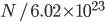
This says that pressure is proportional to particle density and temperature. To make this proportionality an equation, all it needs is a constant somewhere, which we'll just call  :
:

or

This is called the ideal gas law, and it's one of the most well known results in chemistry. It can be derived in a rigorous way, but this understanding is pretty good. Most gases, as long as they aren't at too high pressures, behave very similar to this law.





Another thing we can start to understand is suction. A suction cup is a device that you press against the wall. At first, the cup will not stay up, since there is as big a pressure inside pushing on the cup as there is on the outside pushing on the cup. As you push it against the wall, the cup compresses down and pushes most of the air out, and after the air leaves the cup seals itself at the edge. Then when released, the volume expands but no new atoms come in. From the ideal gas law you can see that if the number per volume decreases, so does $p$. The pressure inside is lower than the pressure outside. So, inside you have some particles running into the suction cup, but on the other side you have way more. The net effect is to produce a net force toward the wall. Who's pushing? The air is!
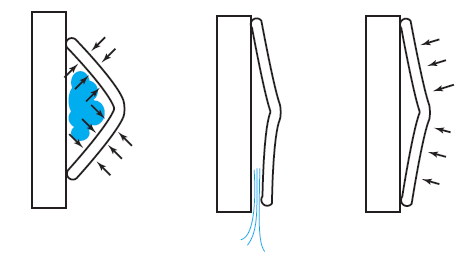
Suction cup operation
The force is  area. If the pressure inside is quite small, then it's about 15 pounds for every square inch of area. This is actually a lot! 15 lbs is enough to keep up a significant amount of weight (using friction between the edges of the cup and the wall). If the air on the outside wasn't there, then there would be no net force, as demonstrated in this video. When he sucks enough of the gas out of the jar, there are no longer enough atoms on the outside of the cup to provide a force holding the metal up.
Any time there's a pressure differential on two sides of something, there's a force. If you cover the end of a straw with your finger, then lift the straw out of the drink, the liquid in the straw defies gravity. Why? When you lift it up, the liquid does start to fall. After a short time, though, the volume of air between your finger and the liquid increases, but no atoms come in, so the pressure there decreases. The other side of the liquid is in the normal air. This makes a net force pushing on the liquid up, which balances the force of gravity, and so the water just hangs there.
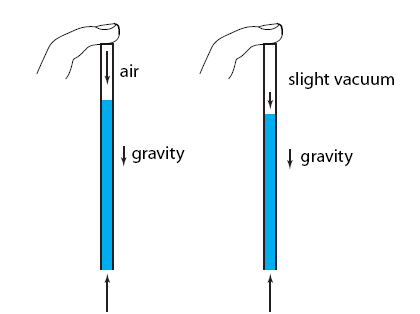
Water suspended in a straw
To clarify, the water is held up against gravity because there are more atoms crashing into the bottom than the top.











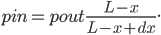


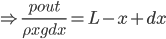
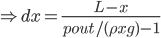
If the straw is 6" and we have 4" of water trapped, then the water level only drops 0.010 inches, or about 1/4 of a millimeter. This is a really tiny change! It doesn't take much of a vacuum at all to hold the water up. You'd never notice the change in water level, at least in something like a straw.